
I received a text in late January from an old high school friend asking if I’d like to go on a hike sometime in the next few weeks. My friend had recently left employment voluntarily to enjoy life for a bit and wondered if I’d be up for a trip somewhere warm, perhaps a week or so. I quickly accepted and soon suggested the southernmost 110 miles of the Pacific Crest Trail, from the Mexican border outside Campo to Warner Springs, CA. This section mostly sticks to elevations below 5,000 feet, promising decent weather for a late February hike.
I’d sworn off flying for the next year after a recent trip for work from my new home in northwest Washington back to the Midwest. The brutal disdain for humanity apparent in every facet of the modern airport/airplane experience drives me to anxiety and depression, and yet I found myself happily booking a flight to San Diego just weeks after returning to the Pacific Northwest. I even decided to pay a little extra to fly in/out of my little local airport instead of SeaTac. Quicker than the 2.5 hour shuttle each way, I told myself.
I leaned on my knowledge from last year to get us to the trail via public transportation. The 894 runs from El Cajon to Campo—a nearly two-hour journey by bus—every weekday a few times a day, at the reasonable cost of $8 one way. The plan for returning to civilization from Warner Springs, a little outpost in the middle of nowhere, SoCal, was something along the lines of, “I don’t know, we’ll hitch it or something.” Good enough.
It was a pleasure to see my friend in the lower level of the San Diego terminal following a year and a half apart. He’d shaved and cut his hair but was still the same person I’d last seen in October 2018. The heat drove off our layers immediately as we exited the airport into sunny San Diego. The faint humidity from the ocean gave the early afternoon’s warmth an embracing feeling, one welcoming and particularly redolent of the sense of vacation. We caught an Uber to El Cajon, where our hotel awaited.
Only the finest Motel 6 double, of course. The cheap hardwood laminate, sterile décor, and mold-ridden air conditioner gave the impression of somewhere between an asylum and a dentist’s lobby—and apparently Motel 6 no longer believes guests wash their hair with shampoo, providing only two bars of soap for the room’s line of complimentary hygiene products (not a unique experience, I can say after staying at another one of these forsaken hellholes for some masochistic reason upon my return to San Diego at the end of this trip)—but it was a cheap place to stay for the night while we prepared our gear and ourselves for the hike ahead.
My friend had dramatically overpacked, resulting in an hours-long shakedown to rid him of unnecessary gear and food, at one point encompassing both uncomfortable beds. He decided to mail the excess stuff home. This was fine, as I needed to stop at the post office in Campo in the morning anyway, to pick up the bits of gear the pleasant and wholly necessary folks at the TSA view as contraband in carry-on luggage that I’d mailed ahead (again, a tactic that had worked well last year).
As I was smoking a cigarette in the grungy hotel parking lot at the interchange of Magnolia and I-8, a transient wandered through, playing a nameless tune surprisingly well on a harmonica. I wondered briefly if my shoddy health insurance would cover any injuries sustained in Southern California, then decided not to worry about it.
We were the only hikers on the bus the following morning. I’d forgotten how hard the seats in the bus were. Hostile design rearing its lovely head once again. My ass was nearly numb when we arrived in Campo just after 10 AM, the temperature somewhere in the low-60s under mostly sunny skies. It was a near perfect day to hike.
After a brief stop at the post office, we walked south through the barely existent town of Campo. We passed the local border patrol facility, complete with a cramped cage half-covered with tarps by some lazy fascist, packed with a couple dozen brown-skinned immigrants, mostly women and children by the glimpses we got. It left a sour taste as we walked the dusty streets south toward the border and the PCT southern terminus monument.
The mile-and-a-half to the border is a slow but steady climb, and by the time we reached the monument I was painfully aware of how out of shape I’d gotten in the winter. It had been nearly four months since I’d last hiked more than ten miles, I realized in some shock. Just seven months prior I’d hiked marathon days with ease. The thought of pushing that many miles now made me laugh.
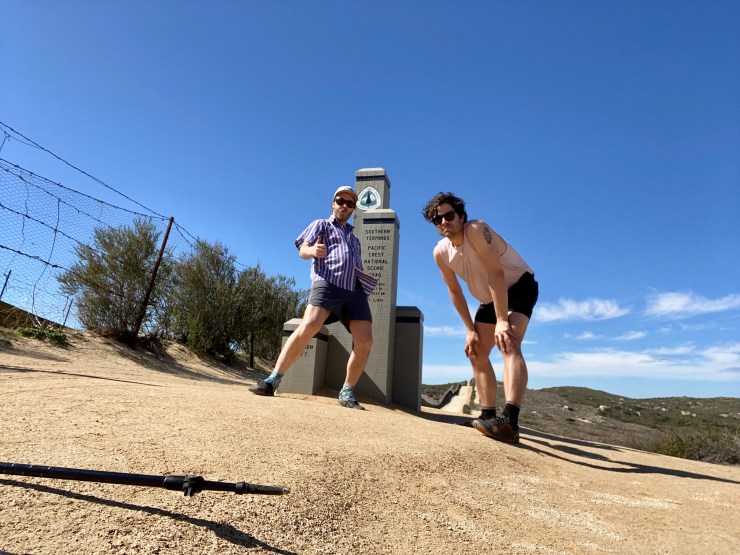
The monument was the same as ever, though this year it was just my friend and I gathered before it. Last year I had found myself in the company of roughly ten others who’d similarly opted for public transport over the generosity or obligation of others, plus a few PCT volunteers keeping track of numbers. The informality of this year’s beginning felt much freer than last year’s, and I found myself nostalgic for a time I never knew, when these trails were nearly empty compared to the enormous popularity of thru-hiking America’s long-distance scenic trails today—a problem to which I knowingly contribute, caught up in the same wave of outdoor awareness. At least getting on the trail before the PCTA’s newly-designated Southern California PCT Thru Hike Season of March 1 – May 31 allowed us a glimpse of the sort of solitude every thru-hiker enjoyed (or suffered through) decades ago.
We signed the trail register and snapped a few vanity pictures before setting off on the trail proper. 110 miles north was the goal. We began the morning of Friday, February 21. My flight home was booked for 7:30 AM, Saturday, February 29, so we had a solid week to hike the miles and figure out how to get back to the urban corridor along the shore. Turning away from the hideous corrugated steel fencing to face the sprawling Southern Californian mountains, we passed the first trail marker and were on our way.
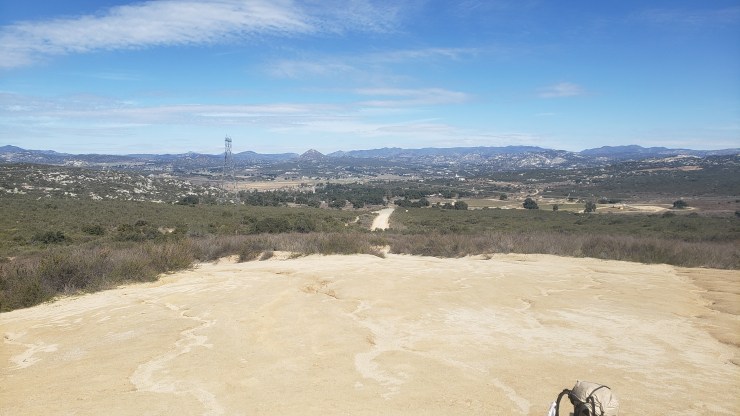
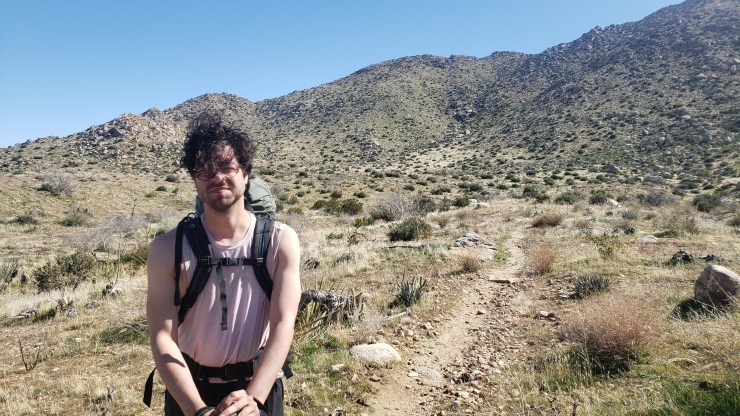
To avoid dealing with permits, we had to stick to a fairly rigid itinerary the first three days. This schedule happened to match that of my hike last year, so it would be fairly easy to manage. By mile six, I found my heart pounding, my feet hot, my shoulders sore, and my head swimming under the desert sun. Ah, the joys of backpacking.
We hobbled into camp at mile 11.3, sore but satisfied with a decent first day. Border Patrol helicopters continued droning above this way and that, as they had all day. Rain loomed on the western horizon, and was forecast to persist through the following day, after which we were to have clear weather. One day of rain would be manageable, particularly as we would encounter the precipitation before ascending into the Laguna Mountains, where that rain could have well been snow. The gathering clouds provided a canvas on which the setting sun painted a remarkable scene of molten gold.
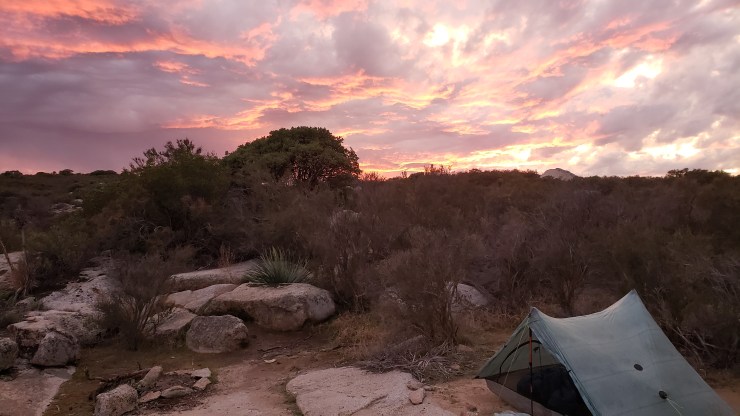
I slept like the dead and my friend reported the same. Remarkable how comfortable a narrow air mattress on firm earth can be after a hard day’s hiking.
The rain held off most of the morning as we ascended Hauser Mountain, though we found ourselves caught in a downpour of cold bullets and sharp sleet less than a mile out of the Malt Shop in Lake Morena. We dried off while inhaling well-earned (20 total miles is well-earned, yeah?) double bacon cheeseburgers. The rain let up a few hours later, so we set off to our destination of Boulder Oaks Campground, six miles further up the trail.
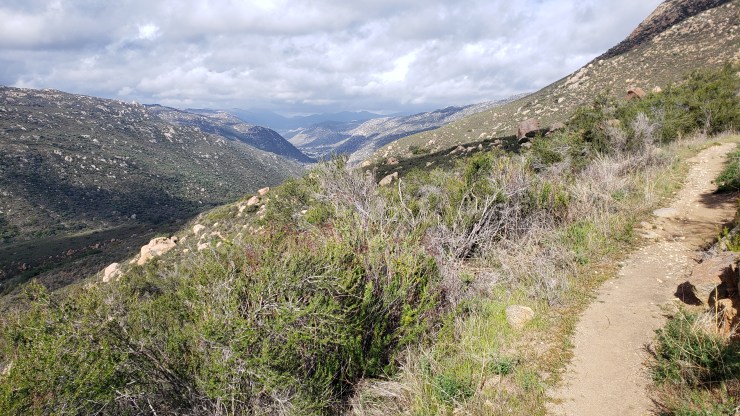
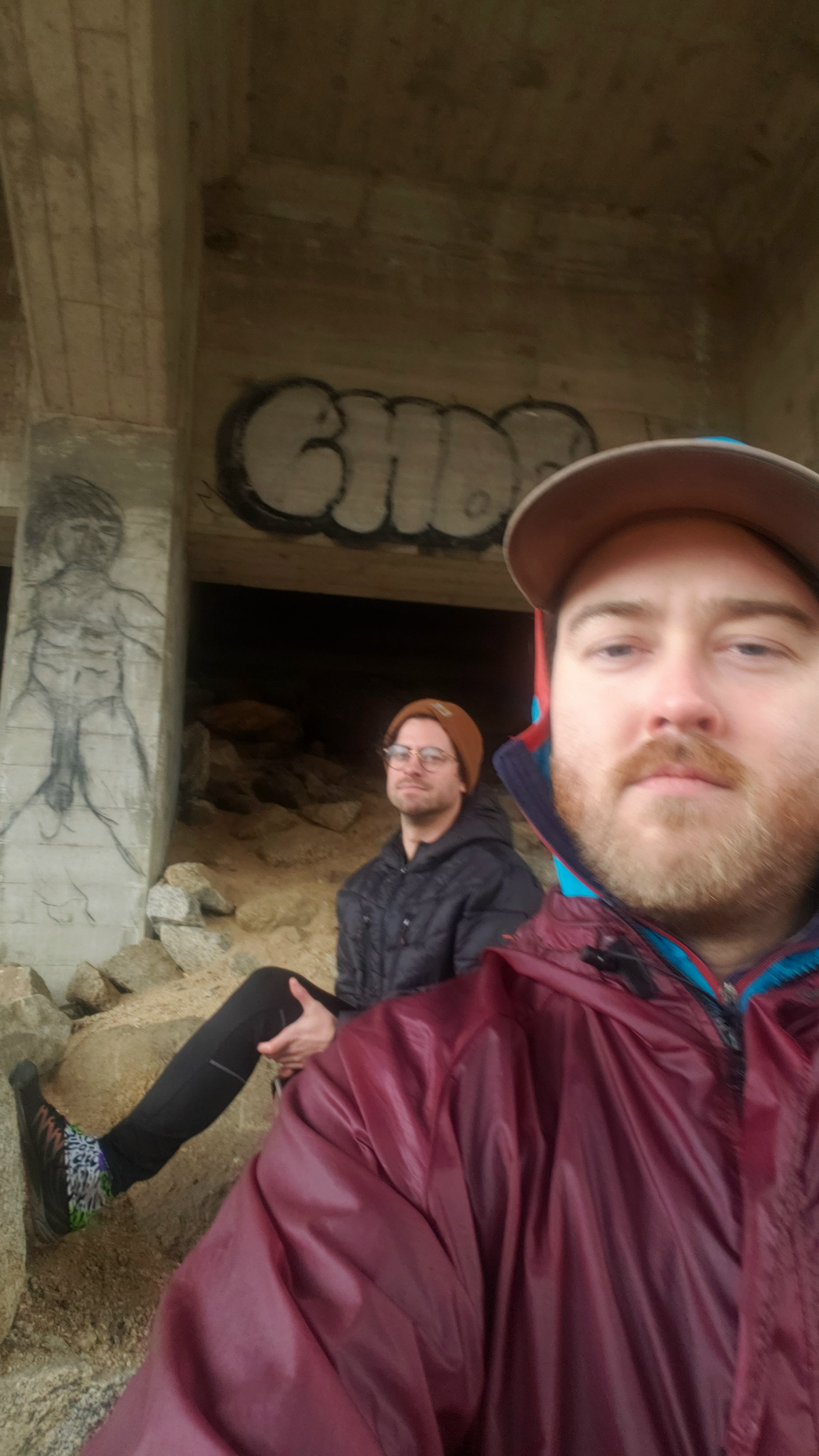
Another spell of rain trapped us below an overpass, where we enjoyed the talents of the local graffiti artists. The rain passed again, and we walked the last couple miles through a years-old burn area next to the road beside the creek, an oddly pleasant section on trail in my opinion. The surviving oaks tower here over unkempt shin-high grasses, most evidence of desert chaparral missing entirely. Then one crosses the creek over a few well-placed boards, and the oak grove gives way to desert scrub once more, until the trail meanders into Boulder Oaks Campground, where the two biomes merge.
It quickly became frigid as the sun set below lingering rain clouds to the west. A few more periods of rain passed over during the chilly evening, and I found myself wearing most of my layers to stay warm. The desert is certainly a place of extremes and loves to remind hikers of it when it can.
Clouds hung around the following morning, but the rain held off as we climbed into the canyon above Kitchen Creek and beyond, up the slow but steady fifteen-mile climb to Mount Laguna. Eventually the sun broke through and turned it into a lovely day.
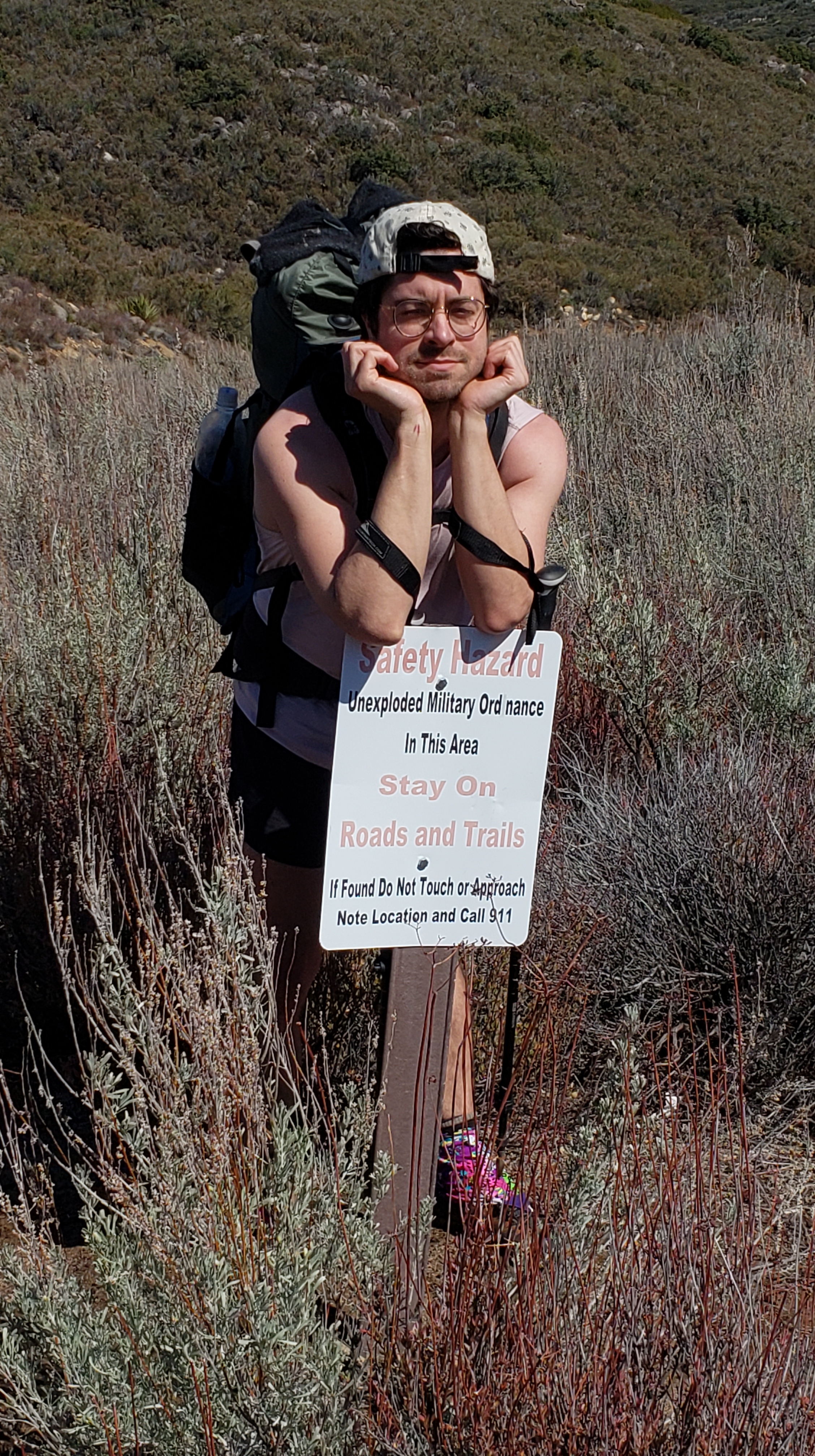
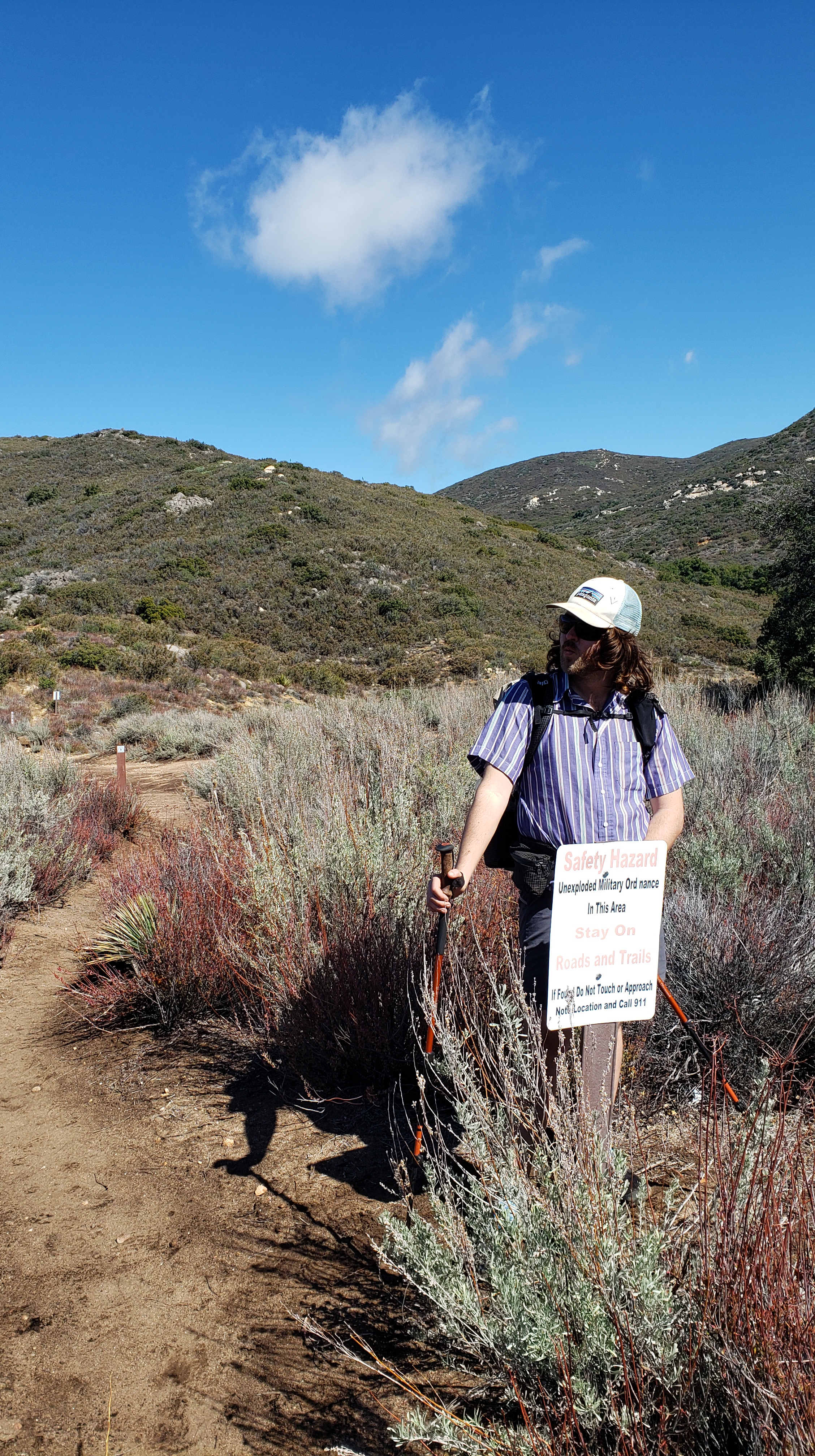

After arriving in town, we debated our plan for a bit before deciding to grab a bite at the Tavern/Cafe there. A delightfully odd experience in every regard, from the overbearing but kind owner who hissed at her cook when an exuberant “Oh shit!” came from the kitchen, the sort a guy issues when watching on a handheld screen a good sports play or another guy getting hit for something he probably deserved, to the nearly comedic in appearance couple, decked to the nines in proper cowboy regalia, his sixty-plus years to her barely-forty, his gray mustache as prominent as her pushed up cleavage. After some subpar house special mac and cheese, I waited for the male component of the cowboy couple while he used the restroom before me. Apparently, the man shit cologne, judging by the odor lingering after he left, heels clicking loudly on the knotty wood floor.
Having gently disregarded the instructions on where exactly we should camp, we suffered through another cold night. At nearly 6,000 feet, it fell below freezing into the upper 20s the third night. I awoke several times shivering, my pad having a slow leak that necessitated a few supplementary breaths throughout the night. R-Value is real, folks.

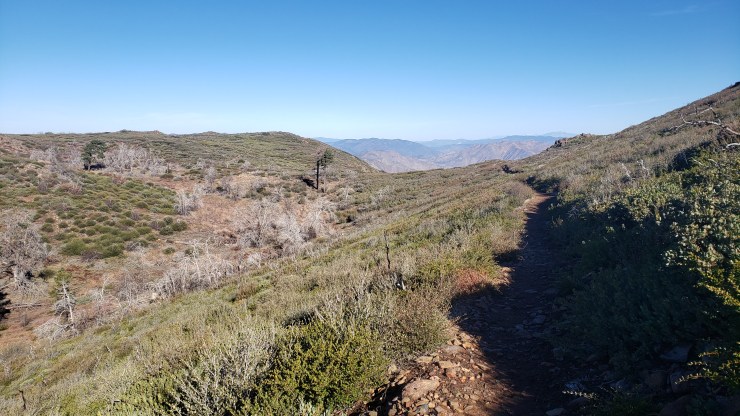
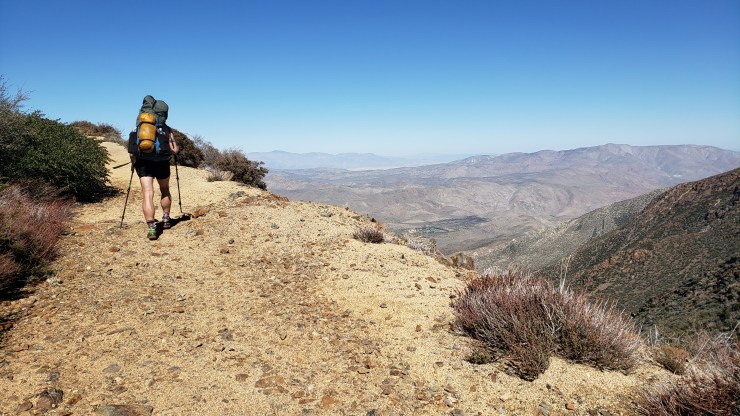
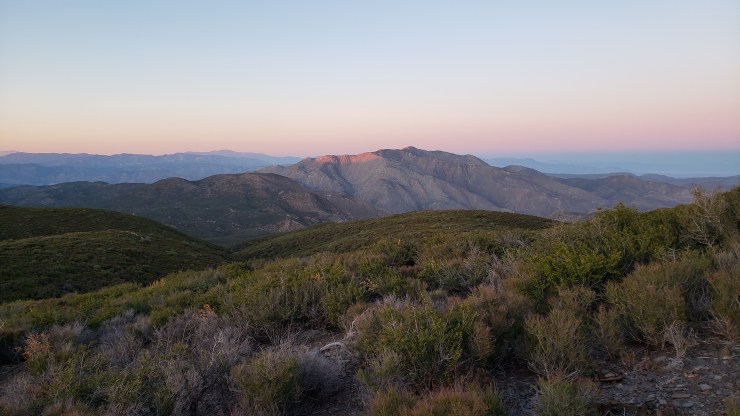
We rose to blue skies, and once the sun crept above the trees just after 7 AM, the day quickly warmed and became a perfect day to hike. The trail opened up a few miles in to, in my opinion, the gem view of the first hundred miles, looking north and east to the low desert. It is an incredibly huge view, particularly for a couple Midwestern kids. I’ve hiked well over fifteen hundred miles out west now, and the grandness of it all still leaves me breathless. There is simply no comparison to be found in the mostly flat forests of Wisconsin or Minnesota.

Cresting around narrow sections of trail that have a hiker walking a two-foot (at most) wide path between a near-vertical stone wall on their left and a thousands-foot sheer drop on the right, we joked that these are the parts of trail you don’t tell your mom about. I am awful at following this advice; so, sorry, mom. At least there weren’t 50+ mile per hour winds here this time.
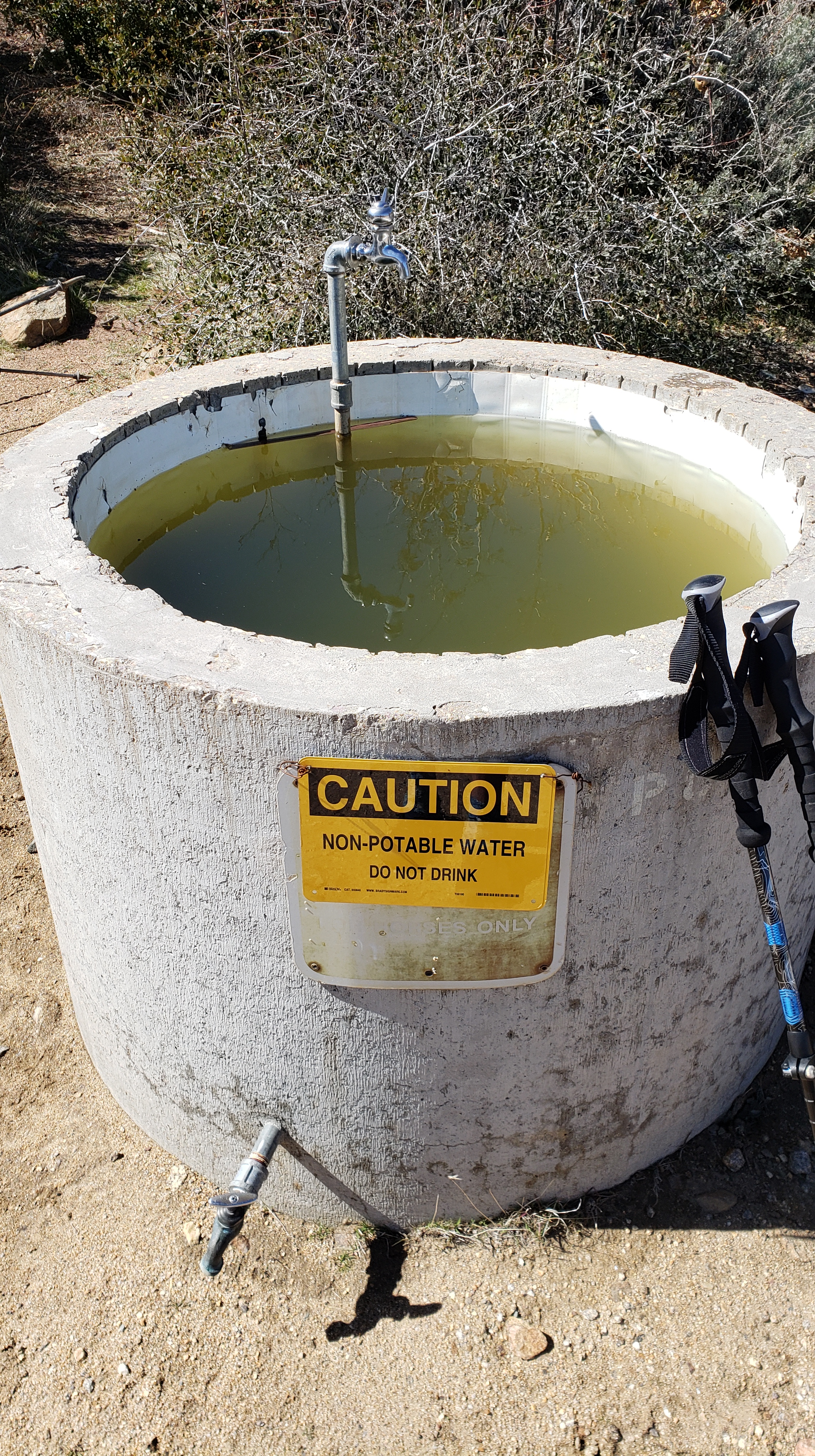
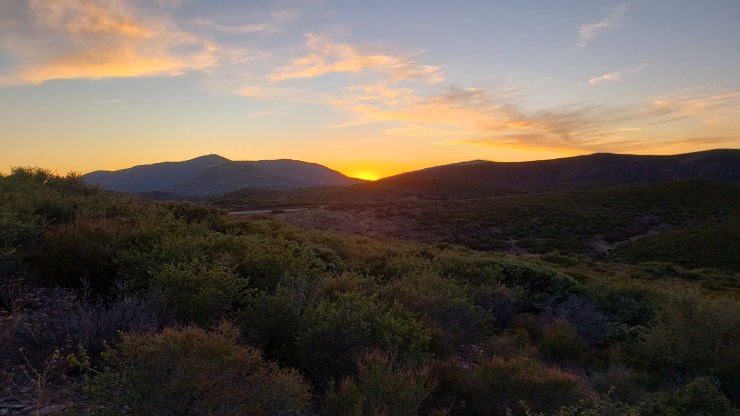
We found a place to camp amid stout manzanita trees, tucked into a little valley to block most of the winds. We were still around 5,000 feet, the sturdy SoCal winds ever-present along the slowly descending ridge from Mount Laguna to Scissors Crossing. A spectacular sunset and sunrise were both to be had here with a short climb out of the valley. The myriad layers and shades of pink, violet, and blue were enchanting in their own unique ways with dusk and dawn, from the cotton candy clouds drifting lazily by in the evening to the coral sky warming along the eastern horizon with the new morning’s first light.

The fifth day was to be our longest of the trip. The initial plan was to hike the remaining 18 or so miles down to Scissors Crossing, get a hitch the three or so miles down the road to the Stagecoach RV Resort and Campground, and enjoy some food from their grill before camping there for the night. Julian, fifteen or so miles up the road the other way, would be on the following morning’s agenda for brunch before a shorter day to rest our legs a bit.

The plan, like any good plan, went to absolute shit. This turned out to be an incredibly fortunate twist of fate, we would later learn.
We hiked the day’s miles easy enough. The question of how we would get from Warner Springs back to public transport routes to go our separate ways at the end of the hike arose once more, this time more pressingly as we approached the hike’s end. My friend brought up that there was a bus from Julian to El Cajon on Friday morning, though our present itinerary would have us nowhere near Julian by Friday, Tuesday as it was. I, however, was inspired—nothing said we needed to hike the miles sequentially.
I suggested that we hitch from Scissors Crossing to Barrel Springs, 34 miles up the trail. From there, we could day hike to Eagle Rock five miles north, then turn back and proceed to hike south Wednesday and Thursday back to Scissors Crossing, arriving in time to catch the bus Friday morning. My friend agreed, so the new plan was to hitch to the RV Resort for food and resupply, then either camp and hitch to Barrel Springs in the morning or manage a hitch that night if we could.
We got to the road at Scissors Crossing around 1:30 PM and caught a hitch to the RV Resort right around 2 PM. The plan seemed to be going well until we arrived at Stagecoach to find they were closing early for the day for training purposes. We were offered the option to camp, which we briefly considered, but the broken promise of real hot food was too bitter to swallow. So, we declined and stood at the roadside, trying to hitch the three or so miles back to Scissors Crossing, where we would try for another hitch up to Julian for food and resupply.
The remaining hours of daylight were quickly fading, with the sun setting before 6 PM and full dark coming well before 6:30. After nearly a half-hour of no luck hitching, we began the hour-long road walk back to Scissors Crossing, cursing our luck.
About halfway through the road walk, a car passed, and its driver gave us an odd look. A moment later, the same car returned, pulling off to ask us where we were headed. “Julian,” we said, and she invited us in for a ride. The car was delightfully filthy, its middle-aged woman driver quirky and pleasant as she sped up the winding mountain road to Julian.
We arrived around 3:30 PM, less than two hours of proper daylight remaining. We had no intention to stay in Julian, as there is no affordable (read: less than $20 per night) camping or lodging in town. A brief but delicious late lunch at Miner’s Diner followed by a quick resupply at the corner market and a stop at the ATM, and we were ready to leave town by 4:45 PM, thumbs out at the roadside.
5 o’clock came and went without a ride as the sun began to slip below the tall trees of Julian, a fierce eastern wind ripping through town. We began to discuss getting a room at the local bed and breakfast (at over $100 per night) when another vehicle pulled a U-turn after passing. She asked if we were going to Scissors Crossing and we said yes; she said she was going there as well and offered us a ride with a smile. A fit middle-aged woman with vibrant red hair, she opened a trunk to reveal an HMG pack and other familiar gear. We were in good company.
Along the way, our new friend explained that she was out scouting water locations in preparation for her coming thru-hike attempt in March. She seemed cool and nice enough, so I asked if she’d be willing to drive us a bit further up the road, to Barrel Springs. Though it’s 34 trail miles between there and Scissors Crossing, it’s only a fifteen-minute drive. She agreed and turned up San Felipe road when we hit the crossing, dropping us off right at sunset at mile 101.5, Barrel Springs. We said our many thanks and bid her farewell, hurrying into camp to set up before dark.
Despite the setbacks, we’d accomplished the best possible plan, all before dark, at that. We couldn’t believe our luck, laughing repeatedly at the ways the trail provides as the stars came out above the tall oaks surrounding the dry riverbed upon which we camped.
Late in the night, or early in the morning perhaps, the wind began tearing above the trees. A few stiff gusts found their way into the sheltered little canyon in which we camped, but judging by the horrible roar above, we avoided the worst of it. In the morning, I checked the local weather, and found there was a High Wind Warning for the area, with sustained winds of 30+ miles per hour and gusts of 50+, including gusts in the early morning hours of 90+ MPH.
Had we been camped at the RV Resort, which is in flat, open desert, or at Scissors Crossing (similar), we would have had a miserable, potentially dangerous, night. Instead, it was a little breezy, and my friend’s rainfly blew off a bit because he’d staked it in loose sand without weighing it down. Overall, not much to worry about. The magnitude of our luck became fully apparent that morning as the wind raged above.
The wind advisory continued for the next 36 hours or so. We talked about the risks of camping in the exposed mountains between miles 101.5 and 77 with the potential strong winds and decided against risking it. Both of our bodies were fairly worn down at this point as well, with neither of us in the shape we had hoped to be in for the hike. We decided to hike the five or so miles to Eagle Rock and back that day, and camp in the same place at Barrel Springs a second night. The next day, we could walk thirteen miles along the road to get back to Scissors Crossing, by which time the wind would have calmed and we could camp at the RV Resort, which happens to be a stop along the bus route to El Cajon Friday morning.
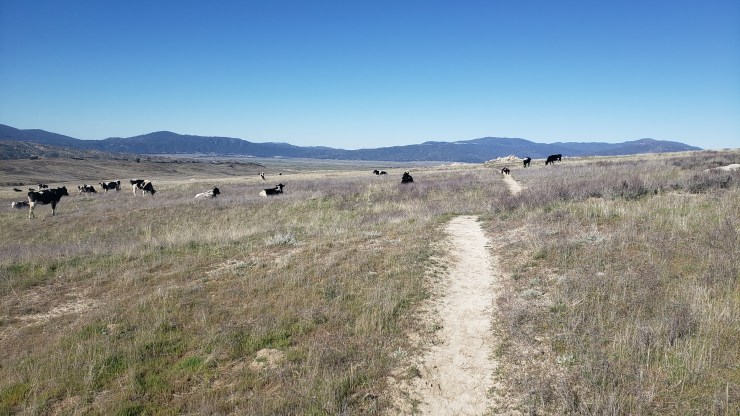
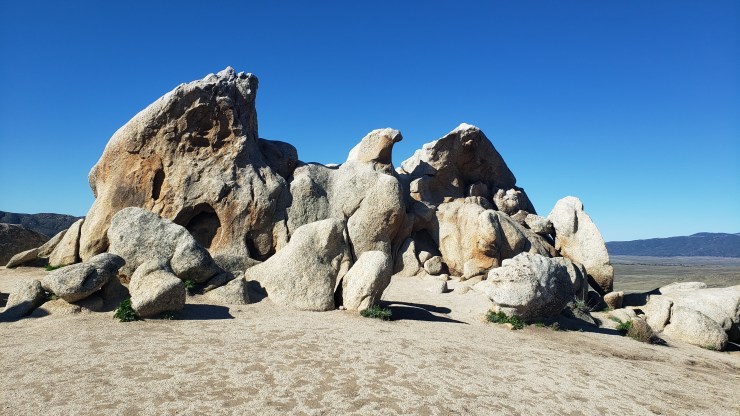
That morning we hiked out to Eagle Rock through the meadows outside Warner Springs. The breeze was strong at our backs on the way out. A herd of cows had decided the trail would be a nice place for a morning graze, so we circumvented the lumbering ladies as their gaze followed us around their little gathering. Once at the natural monument, the wind tore through with renewed ferocity. We meandered around the pile of rocks a bit before turning back the way we’d come.
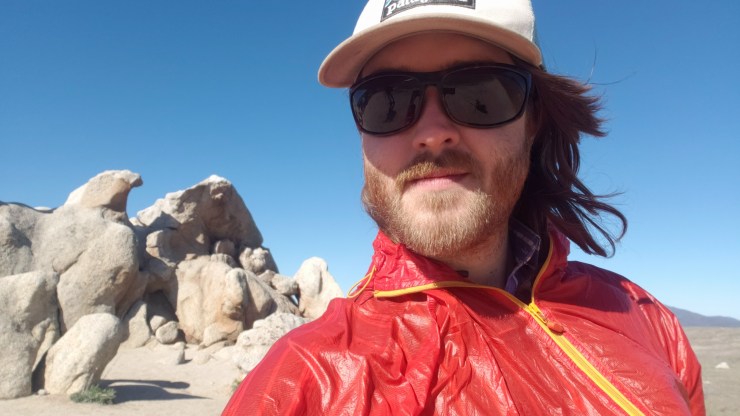
30-40 mile per hour winds bore down on us from ahead as we made our way back. It was exhausting work to push through the meadows that morning against the gale, like wading through chest-high water. By the time we returned the five miles to our sheltered campsite at Barrel Springs, we were both drained and sore, the week’s hiking catching up to us. We spent the afternoon lounging in the sands at Barrel Springs, grateful for an afternoon to relax and recover.

We walked out to the road as the sun began to set in our little valley, the chill of desert night following behind the sinking daylight. The road would provide a few extra minutes of warm radiance to soak in before layering up for the long night. A U-haul truck was parked in the small lot off Montezuma Valley Road, bearing an advertisement attached to its rear. CONGRATULATIONS PCT HIKERS ON 100 MILES, it read. Below that, a little market’s wares were flaunted, including beer, chips, cigarettes and ice cream. CALL FOR POSSIBLE RIDE/LODGING, the sign read. A quick Google showed the place to be open for another hour or so, so I hopped on the phone and asked for a quick ride to pick up some beer and snacks for the evening. Five minutes later a woman in a flashy new Nissan coupe arrived and whisked me away a few miles down the road to her little market, where I grabbed a few 24oz cans of Modelo, a pack of smokes and a large bag of Doritos.
On the ride back I was advised by the proprietor and her male companion that there are loads of big cats in these hills, and that some mountain lion had now claimed two cyclists near Los Angeles as dinner, and had I seen any of these? Bears, maybe? No, I said, never seen a big cat or bear on the PCT in over 1500 miles. They seemed disappointed that I lacked any harrowing tales to share. I did see a tarantula’s ass as it skittered into its burrow last year but decided not to mention it. The four—count ‘em, four—rattlesnakes in total last year didn’t seem worth bringing up, either. I get the impression that rural SoCal residents hold some measure of pride for the supposed deadliness of their local terrain and fauna. Like many things in California, it doesn’t make much sense to me.
That evening, just before dark, a pair of PCT hikers rolled into the large campsite. We had seen a handful of names in the days before us in the trail register in Campo, so it made sense to finally see some of the people to which those names belonged. The pair of guys were perfectly asocial, barely bothering to return a raised hand in greeting.
We were slow to get going Thursday morning, with only a thirteen-mile road walk ahead. We were off just before 8, walking the mile up Montezuma Valley Road to turn onto San Felipe and head south back to Scissors Crossing. We tried and failed the first couple miles to hitch as we walked, then eventually decided to enjoy the road walk for what it was and make the miles under our own power. The west side of the road eventually opened up to provide a sweeping view of meadows and mountains beyond. Under a partly cloudy sky with a pleasant breeze, we made the road miles quickly and enjoyably.
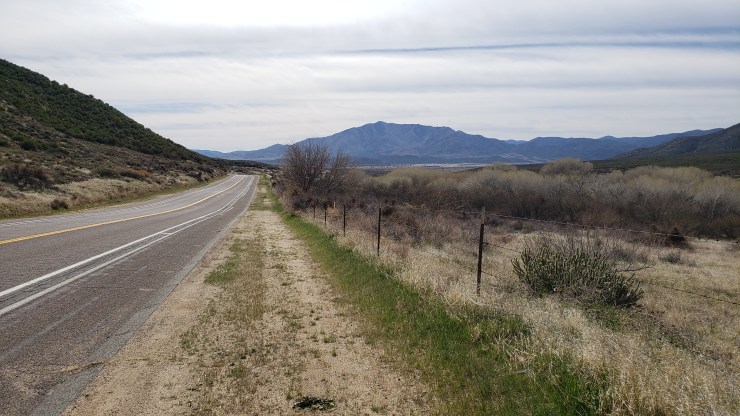
With just a mile or so to go, a minivan pulled off the side of the road next to us, asking if we needed a ride anywhere. I quickly recognized its driver as a trail angel who’d given me a ride last year, and so we clambered in, getting driven to the RV Resort one last time. Ghost is a kind man with a grizzled beard who spends a few months each year helping fledgling PCT Hikers on their way through the Scissors Crossing/Julian area. He dropped us off at the RV Resort, where we got a hot lunch and paid for a campsite.
The afternoon was spent going through our gear and supplies, tossing any collected garbage that had stowed away in our packs during the week. We did some laundry in a facility with too many signs bearing stern instructions for any of them to mean anything and generally lazed about on our last day in the desert.
Friday morning was cold and cloudy. We waited out front of the RV Resort along the old stagecoach route, craning our necks to see around the distant corner at the sound of any engine humming its way up the hill. An old man wandered out from the RV Resort to the road’s edge, old flip-phone in hand, complimenting us on our apparent knowledge of the bus schedule despite one not being posted at the bus stop. He then turned west and wandered into the chaparral and cactus of the desert, disappearing below the chamise without a word.
The bus arrived ten minutes late. We joined four men already riding its long route from Borrego Springs to El Cajon. Unlike the city bus that took us out to Campo a week earlier, this rural bus was a shorter bus with forward-facing seats that actually bore a modicum of cushion and comfort. While one of the men was silent beside his large piece of luggage the whole journey, the other three were engaged in a lively discussion, one we walked in on the moment we boarded.
The conversation was so scattered and bizarre that to try to capture its full essence here would be nigh impossible, though a part of me deeply regrets not transcribing any of it in the moment. Some highlights as best I can recall:
A lengthy discussion on the merits and individual preferences of each man regarding berries.
An insistence by one man that the British stained their teeth with tea to avoid decay, leading to full—though brown—smiles. (Intrigued, I later researched this and found no evidence of the British doing it. However, it used to be very prominent in some Asian cultures, and still occurs in some—though tea is not the dye of choice. https://en.wikipedia.org/wiki/Teeth_blackening)
“Well my family was military. Moved around a lot.”
“You were military?”
“My family. Dad was. I guess I didn’t really know him. Apparently, he and my mom never were close. You know what people do.”
“Mmhmm.”
“So, they did that and here I am. It’s fine. I know my cousins.”
“Your cousins? What about your parents?”
“Don’t know. It’s great. Don’t have to worry about it like most people.”
A theory on the once-prominent geysers around Palm Springs, CA, and the government’s supposed “capping” of them.
“They’re welding the doors shut if you have a cough or fever. Chinese communists… they’re literal gangsters. The people are getting tired of it. They’re not going to last for long.”
All three men becoming incredibly interested in the wild turkeys roaming the mountains near Julian.
“Well, I’m really good at most things, just never found my potential, you know.”
“Oh, what were your best subjects?”
“Natural sciences. Medicine. Forensics, man. If you needed any sort of help with forensics, I’m your guy.”
The third man, who didn’t say much, wearing a pair of clear protective eyewear as he sat on the comfortable red faux-leather bus seat beside his few worn bags of belongings, nodded knowingly at this.
“Ooh, I was awful at chemistry. Got a C.”
“Yeah, I mean, I wasn’t about the grades. I went and took the tests at college but wasn’t enrolled. They never gave me a degree or anything, but I’m smart.”
“Forensics you said?”
“Sure. You know, a crime scene. Say they don’t know where the guy is. But if you look at where someone lives, you can get an idea. You find a piece of clothing or something, it has a smell. The bacteria, you know. I can follow that and find them.” Impressed nods all around.
We arrived in El Cajon around 10:30 AM. The day was hot in the valley, easily 80 degrees under the blazing sun. My friend was off to Los Angeles to continue his vacation a few days longer and visit family. I bid him farewell as he ascended the steps to the trolley platform while I headed into El Cajon toward the post office. I planned to send home the things they don’t let you on the plane with.
There are many homeless folks in the San Diego area, though each one I passed kept to themselves and did not ask for money. Perhaps my having the appearance and smell of having hiked for a week had something to do with this, but I was never accosted. Seeing two men huddle in the shade of a truck parked alongside the road as they searched for veins in their arms was a bit surprising in the late morning daylight, a reminder of the sheltered and privileged life I lead. I was thankful for my place in life as I walked by, wearing hundreds of dollars’ worth of high-performance hiking clothing, carrying well over a grand’s worth of gear on my back. I smoked a cigarette, aware that in most cities this would result in what I’ve dubbed the City Cigarette Tax, otherwise known as the inevitable request for a cigarette from someone down on their luck. I accept the odds on this and feel decent about myself for never begrudging those who ask—I freely give out smokes if someone wants one. A petty gesture of solidarity. No one asked that day.
A trolley ride, a few good tacos and a short walk later, and I found myself checking into another Motel 6, the nexus of pre-travel suffering. The walls were thin enough that I could hear every word of every conversation from both of my neighbors, along with what sounded to be a vigorous wrestling match from one room and a 3:30 AM wake up with blaring cable news from the other. If I ever stay in a Motel 6 again it will be against my will and likely the last moments before I am harvested for organs in a moldy bathtub. I was all too grateful to leave the room just after 5:30 AM to call an Uber for my early morning flight.
Going through security at San Diego Int’l was the most grotesque display of literal human herding I’ve seen in some time. Following my dealings with a painfully slow robot check-in booth (why they have decided to emulate in these the pace and apparent urgency of an actual airport employee escapes me entirely), I was ushered into a twisting, labyrinthine queue of miserable humans, snaking in rows between a CNBC store and some other overpriced hellhole before it vomited out in front of the doors to Terminal 2 where I joined its awful ranks as it continued to swell in the morning rush of travelers. This massive herd was separated by a somewhat functional walkway, on the other side of which two TSA employees occasionally waved across a couple dozen cattle to the next bit of line before the body and luggage scanners. I smiled some twenty minutes later at the horrified newcomers crossing the gap between the first herd and second, cautiously making for the open TSA PreCheck line before realizing that, no, they are not one of the Chosen Few, as they were cast to the end of the pleb line where it vanished into the ether, terminating perhaps somewhere out in the badlands of eastern San Diego County.
Another ten minutes and I was on The Other Side at last, and this line moved somewhat quickly. Within minutes I was bending over awkwardly to untie my shoes and assault any nasal passages unfortunate enough to be in my proximity. A week of hiking in the desert will make any pair of shoes stink, but particularly a pair that already has 500+ miles on them.
A father just before me was struggling with the terse instructions from TSA to deconstruct the stroller in which his infant son rested before going through security, and the line paused waiting on him. After finally removing the car seat and collapsing the stroller to place it on the conveyor belt along with a bucket of other baby gear, he went through the side with his son and the belt began to move again at last. The stroller got stuck trying to pass into the x-ray device, too wide to fit through. The older Hispanic TSA agent gave me an apologetic look as he removed it, and finally my own possessions went through. The TSA agent fumbled with the stroller to the side of the line, unsure of where it needed to go next, and I felt a twinge of sympathy for the man. We were equally miserable, after all.
There was a four-hour layover scheduled before my 45-minute flight home from SeaTac. I paid $44 and took the shuttle a half-hour after landing in Seattle instead.
 Mellow Travels
Great narrative Jake. I love your witty writing style! Anxious to read your novel. Love, Grandpa
>
LikeLike